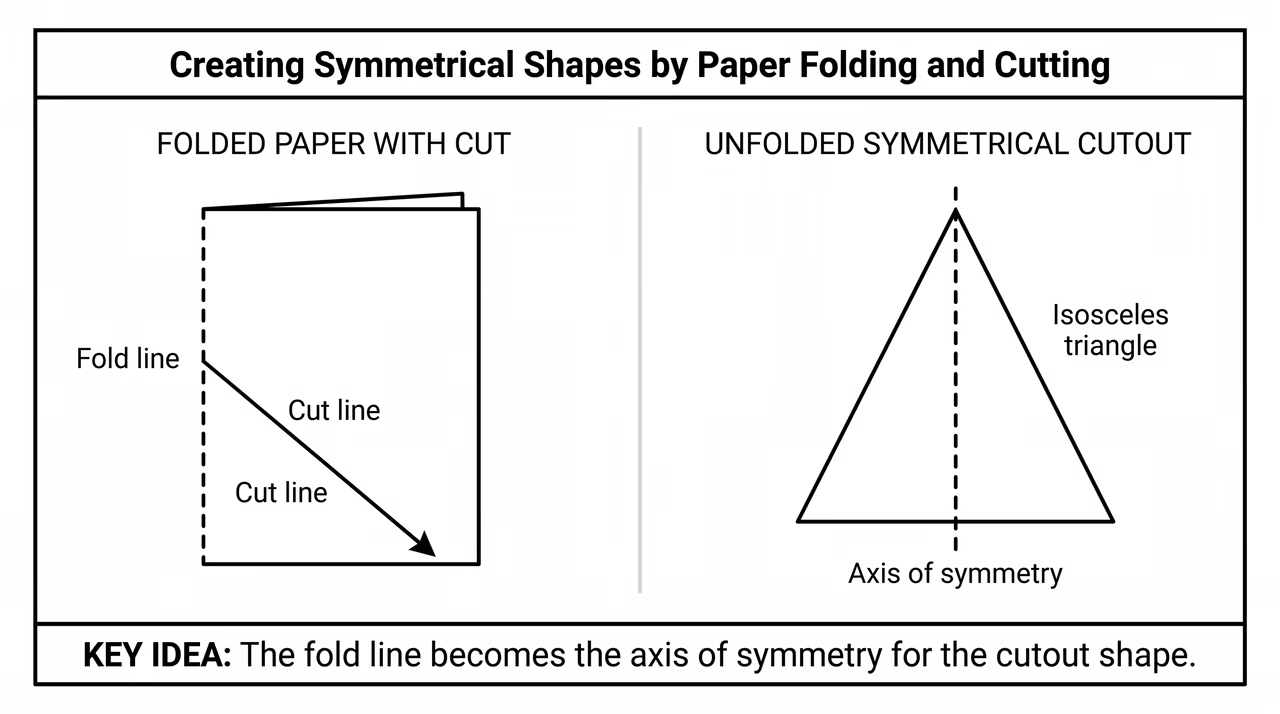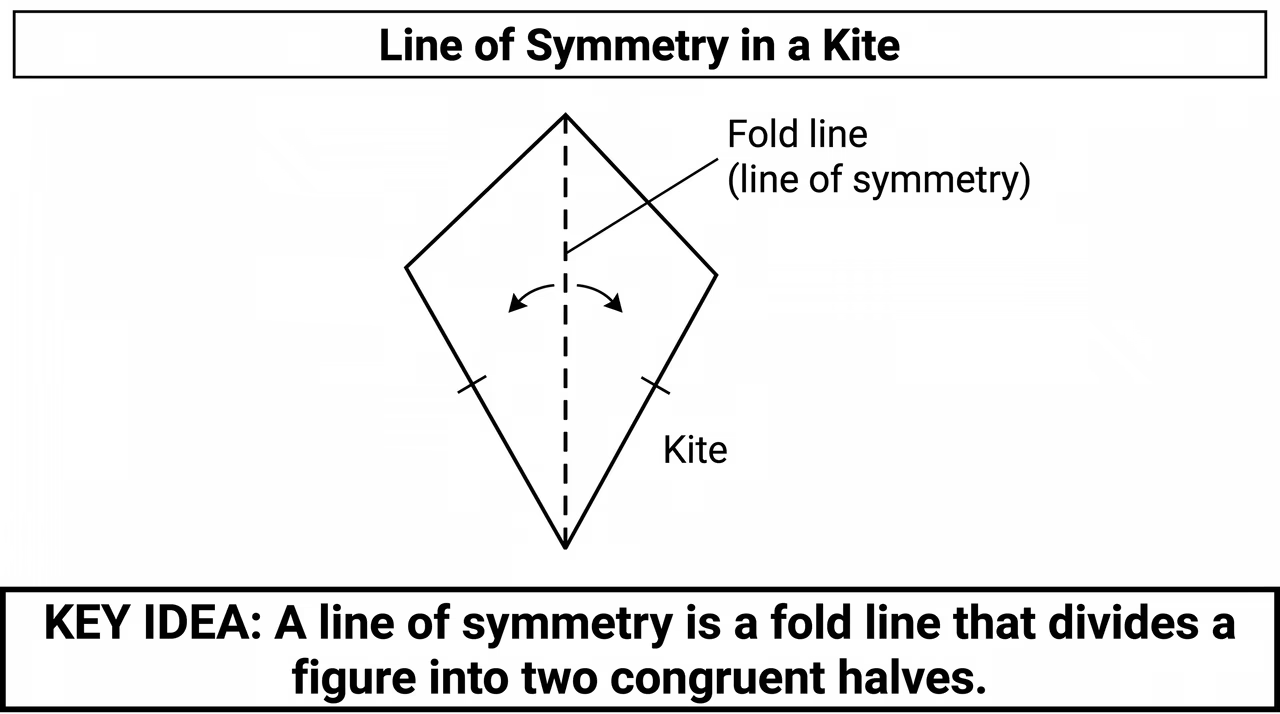
When a plane figure is folded along a straight line and its two halves cover each other without overlapping or overhanging, that crease is a line of symmetry. Line symmetry occurs when every point on one side of the fold corresponds to a matching point on the opposite side at an equal perpendicular distance. Tracing and folding flat shapes helps us visually verify whether two halves are congruent and identify all axes of symmetry. See Figure 1 for an example of folding a kite along its line of symmetry.
- A line of symmetry divides a plane figure into two congruent halves that fit onto each other exactly.
- An isosceles triangle has one fold line through its apex along which its two equal sides coincide.
- Paper folding allows learners to test for line symmetry by matching corresponding edges and angles directly.
- When a figure maps onto itself across a fold, that fold line forms an axis of symmetry.
Check question: An isosceles trapezium has parallel bases of length and , and non-parallel sides of length . How many lines of symmetry does this trapezium have?
- 0
- 1
- 2
- 4
Show answer
1. Folding vertically through the midpoints of the two parallel bases maps one non-parallel side of length exactly onto the other, meaning there is exactly line of symmetry.