
Skip to content

Grade 10 · Core Mathematics · Lesson 2 of 11

Identifying Lines of Symmetry in Plane Figures

A Grade 10 Core Mathematics CBE lesson from the sub-strand Reflection and Congruence. In it, learners define a line of symmetry as a dividing line that splits a plane figure into two identical congruent halves.

Strand Measurements and GeometrySub-strand Reflection and CongruenceLesson code 10CM-22-L240 minutes · 2 slides

KICD learning outcome (a)

Identify lines of symmetry in plane figures.

By the end of this lesson, learners should be able to

  1. Define a line of symmetry as a dividing line that splits a plane figure into two identical congruent halves.
  2. Determine the number of lines of symmetry in regular polygons and compare them with non-regular quadrilaterals like parallelograms and rhombuses.

Key vocabulary

Line of symmetry
A line dividing a figure into two identical halves that coincide exactly when folded.
Folding an equilateral triangle along its line of symmetry maps both halves onto each other.
Regular polygon
A flat closed figure with all side lengths and all interior angles equal.
A regular pentagon has five equal sides and five lines of symmetry.
Rhombus
A four-sided figure with all sides equal in length but non-right angles.
A rhombus has 2 lines of symmetry along its diagonals, not 4.

Lesson preview

Slide 1 · Definition of Line Symmetry and Symmetry in Regular PolygonsModel · 18 min
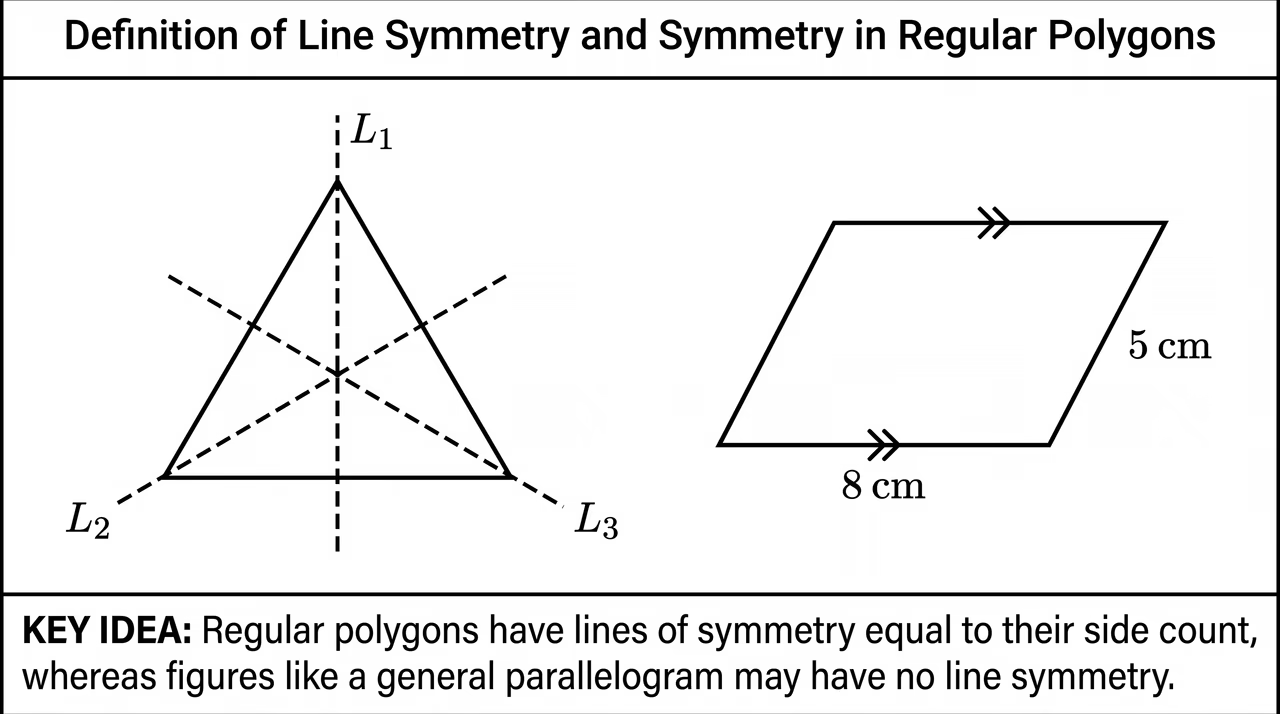
An equilateral triangle with three dashed lines of symmetry is shown next to a parallelogram with none.
Figure 1: An equilateral triangle with three dashed lines of symmetry is shown next to a parallelogram with none.

A line of symmetry divides a plane figure into two identical, congruent halves that fit perfectly when folded. A regular polygon has all sides and all interior angles equal, giving it exactly as many lines of symmetry as it has sides. For example, an equilateral triangle has 3 lines of symmetry passing from each vertex to the midpoint of the opposite side. Conversely, a parallelogram that is not a rectangle or a rhombus lacks line symmetry because folding across any axis does not map its sides onto each other. Refer to Figure 1 for examples of an equilateral triangle and a general parallelogram.

  • A line of symmetry splits a geometric figure into two congruent halves that overlap perfectly upon folding.
  • Regular polygons have equal side lengths and equal interior angles, producing symmetry lines equal to side count.
  • An equilateral triangle possesses 3 lines of symmetry bisecting each vertex angle and opposite side.
  • A parallelogram that is not a rectangle or a rhombus has opposite sides parallel but no line of symmetry dividing it into mirror halves.
Worked example. For (a), an equilateral triangle has 3 equal sides and 3 equal interior angles (60∘), making it a regular 3-sided polygon. Drawing line segments from each vertex perpendicular to the opposite side yields 3 distinct lines of symmetry. For (b), folding parallelogram PQRS along any line through its centre or diagonals fails to map opposite vertices onto each other. Therefore, the non-rectangular parallelogram PQRS has 0 lines of symmetry. Answer: (a) 3 lines of symmetry; (b) 0 lines of symmetry.

Check question: How many lines of symmetry do a regular hexagon and a parallelogram (that is neither a rectangle nor a rhombus) have, respectively?

  1. 6 and 0
  2. 6 and 2
  3. 3 and 0
  4. 6 and 4
Show answer

6 and 0. A regular hexagon is a 6-sided regular polygon, so it has exactly 6 lines of symmetry. A parallelogram that is not a rectangle or a rhombus has no line across which it folds perfectly onto itself, meaning it has 0 lines of symmetry.
Slide 2 · Symmetry in Polygons and Special QuadrilateralsPractice · 22 min
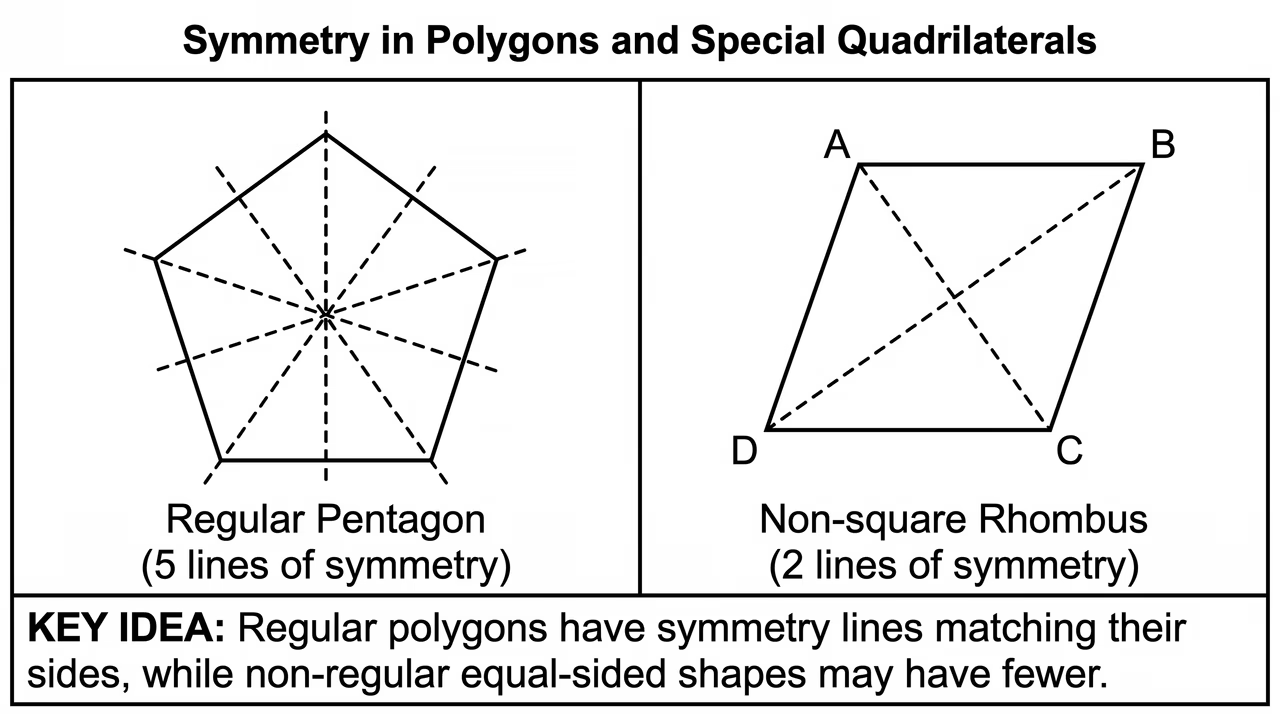
A regular pentagon showing five lines of symmetry alongside a non-square rhombus with two lines of symmetry.
Figure 2: A regular pentagon showing five lines of symmetry alongside a non-square rhombus with two lines of symmetry.

Teach the full lesson on the projector

This lesson, and every other Grade 1–10 CBE lesson, comes ready to project with the EAP ClassKit. It runs without electricity or internet.

  • Both slides with diagrams and class activities
  • Teacher notes, SNE adaptations and assessment checks
  • Homework and the other 10 lessons in this sub-strand

All 11 lessons in Reflection and Congruence

  1. 1Identifying Lines of Symmetry in Plane FiguresIdentify lines of symmetry in plane figures
  2. 2Identifying Lines of Symmetry in Plane FiguresIdentify lines of symmetry in plane figures
  3. 3Properties of Reflection in Plane GeometryDetermine the properties of reflection in different situations
  4. 4Properties of Reflection in Plane GeometryDetermine the properties of reflection in different situations
  5. 5Reflecting Shapes on Plane Surfaces and Cartesian PlanesDraw an image given an object and a mirror line on plane surface and Cartesian plane
  6. 6Reflecting Shapes on the Cartesian PlaneDraw an image given an object and a mirror line on plane surface and Cartesian plane
  7. 7Determining the Equation of a Mirror LineDetermine the equation of the mirror line given an object and its image
  8. 8Determining the Equation of a Mirror LineDetermine the equation of the mirror line given an object and its image
  9. 9Direct and Opposite Congruence in Plane FiguresCarry out congruence tests for triangles
  10. 10Carrying Out Congruence Tests for TrianglesCarry out congruence tests for triangles
  11. 11Real-Life Applications of Reflection, Line Symmetry, and CongruencePromote use of reflection and congruence in real-life situations