Skip to content

Grade 10 · Core Mathematics · Lesson 10 of 11

Carrying Out Congruence Tests for Triangles

A Grade 10 Core Mathematics CBE lesson from the sub-strand Reflection and Congruence. In it, learners distinguish between direct congruence and opposite congruence in paired geometric figures.

Strand Measurements and GeometrySub-strand Reflection and CongruenceLesson code 10CM-22-L1040 minutes · 3 slides

KICD learning outcome (e)

Carry out congruence tests for triangles.

By the end of this lesson, learners should be able to

  1. Distinguish between direct congruence and opposite congruence in paired geometric figures.
  2. State and explain the four standard triangle congruence tests: SSS, SAS, AAS/ASA, and RHS.
  3. Apply congruence tests to demonstrate mathematically that pairs of triangles are congruent.

Key vocabulary

Direct Congruence
Congruence where one shape superimposes onto another without needing to flip or turn over.
Triangles JKL and XYZ show direct congruence because sliding superimposes them without flipping.
Opposite Congruence
Congruence where one shape superimposes onto another only after flipping or turning over.
Reflecting triangle JKL across a line produces a triangle having opposite congruence to it.
Included Angle
The angle located directly between two specified adjacent sides of a geometric polygon.
In triangle ABC, the included angle between sides AB and AC is ∠A.
Corresponding Sides
Sides that occupy matching relative positions in two similar or congruent geometric figures.
Side RS in triangle RST and side LM in triangle LMN are corresponding sides.
Hypotenuse
The longest side of a right-angled triangle, opposite the ninety-degree right angle.
In right-angled triangle PQR, side PR opposite the right angle is the hypotenuse.

Lesson preview

Slide 1 · Direct vs Opposite Congruence and Congruence CriteriaOpening · 12 min
Two pairs of triangles demonstrating the Side-Side-Side and Side-Angle-Side congruence criteria, with matching sides and angles indicated by tick marks and arcs.
Figure 1: Two pairs of triangles demonstrating the Side-Side-Side and Side-Angle-Side congruence criteria, with matching sides and angles indicated by tick marks and arcs.

Congruence tests allow us to verify if two triangles are identical in shape and size without measuring all six components. If a triangle can be slid onto another directly, they have direct congruence; if it must be turned over, they have opposite congruence. The primary criteria for congruence are Side-Side-Side (SSS), Side-Angle-Side (SAS), Angle-Angle-Side (AAS or ASA), and Right angle-Hypotenuse-Side (RHS). Use Figure 1 to see how tick marks denote equal sides and angles for congruence tests.

  • Two figures are directly congruent if one shifts onto the other without flipping.
  • Opposite congruence occurs when a shape must be flipped over to fit the other.
  • The SSS test requires all three corresponding sides of two triangles to be equal.
  • The SAS test requires two corresponding sides and their included angle to be equal.
Worked example. Compare corresponding side lengths of triangles JKL and XYZ: all three corresponding sides are equal (4 cm, 6 cm, 7 cm). Identify the criterion satisfied for the first pair as Side-Side-Side (SSS). Compare triangles DEF and PQR: two sides (5 cm, 8 cm) and the included angle (40∘) match. Identify the criterion satisfied for the second pair as Side-Angle-Side (SAS). Answer: Triangles JKL and XYZ are congruent by SSS; triangles DEF and PQR are congruent by SAS..

Check question: Triangle ABC has side AB=5 cm, BC=7 cm, and ∠B=50∘. Triangle UVW has side UV=5 cm, VW=7 cm, and ∠V=50∘. If UVW is a reflection of ABC, what type of congruence exists between them, and which test proves it?

  1. Opposite congruence; SAS criterion
  2. Direct congruence; SAS criterion
  3. Opposite congruence; SSS criterion
  4. Direct congruence; SSS criterion
Show answer

Opposite congruence; SAS criterion. Since triangle UVW is created by a reflection, it must be turned over to superimpose onto ABC, which means they have opposite congruence. The triangles match via two sides (5 cm and 7 cm) and their included angle (50∘), which satisfies the SAS criterion.

Slide 2 · Applying SSS, SAS, and AAS Congruence TestsPractice · 14 min
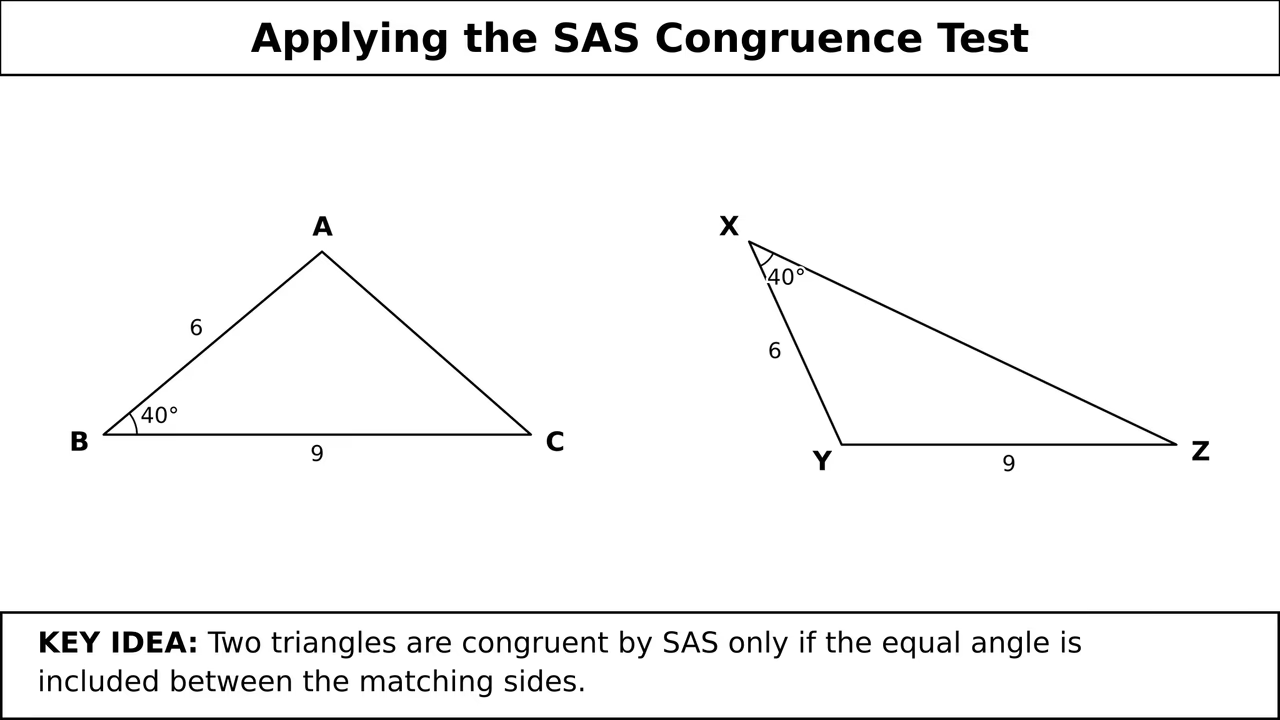
Two triangles with identical side lengths and one identical angle, illustrating the importance of the included angle for the SAS test.
Figure 2: Two triangles with identical side lengths and one identical angle, illustrating the importance of the included angle for the SAS test.

Teach the full lesson on the projector

This lesson, and every other Grade 1–10 CBE lesson, comes ready to project with the EAP ClassKit. It runs without electricity or internet.

  • All 3 slides with diagrams and class activities
  • Teacher notes, SNE adaptations and assessment checks
  • Homework and the other 10 lessons in this sub-strand

All 11 lessons in Reflection and Congruence

  1. 1Identifying Lines of Symmetry in Plane FiguresIdentify lines of symmetry in plane figures
  2. 2Identifying Lines of Symmetry in Plane FiguresIdentify lines of symmetry in plane figures
  3. 3Properties of Reflection in Plane GeometryDetermine the properties of reflection in different situations
  4. 4Properties of Reflection in Plane GeometryDetermine the properties of reflection in different situations
  5. 5Reflecting Shapes on Plane Surfaces and Cartesian PlanesDraw an image given an object and a mirror line on plane surface and Cartesian plane
  6. 6Reflecting Shapes on the Cartesian PlaneDraw an image given an object and a mirror line on plane surface and Cartesian plane
  7. 7Determining the Equation of a Mirror LineDetermine the equation of the mirror line given an object and its image
  8. 8Determining the Equation of a Mirror LineDetermine the equation of the mirror line given an object and its image
  9. 9Direct and Opposite Congruence in Plane FiguresCarry out congruence tests for triangles
  10. 10Carrying Out Congruence Tests for TrianglesCarry out congruence tests for triangles
  11. 11Real-Life Applications of Reflection, Line Symmetry, and CongruencePromote use of reflection and congruence in real-life situations