
Slide 1 · Represent the pairOpening · 18 min
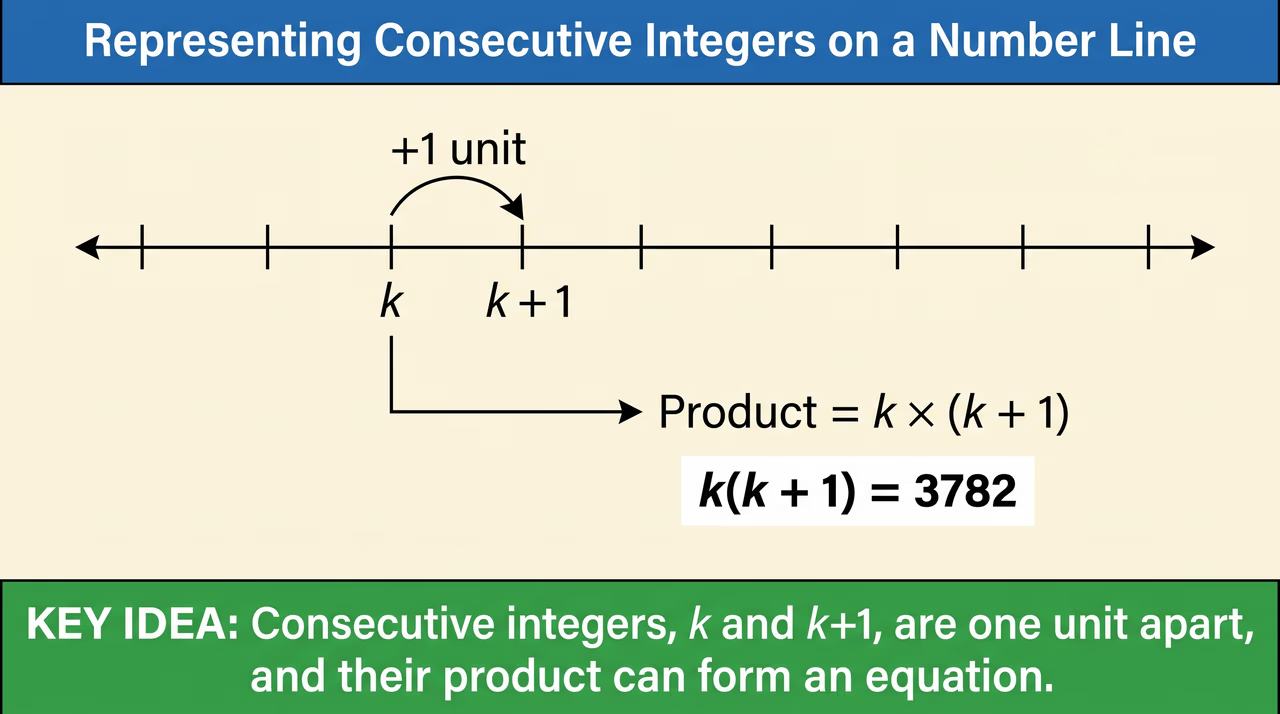
One integer can be named k, so the next consecutive integer is k+1. Their product gives a natural quadratic model. The named consecutive integers make the product condition explicit. Use Figure 1 to see how the product of these consecutive integers forms an explicit equation.
- Define k as the smaller integer.
- Write the next integer as k+1.
- Use multiplication for the product.
- Set the product equal to 3782.
Worked example. Let the smaller integer be k. The next integer is k+1. Set k(k+1)=3782. Answer: The product equation is k(k+1)=3782..
Check question: If represents an integer, what represents the next consecutive integer?
Show answer
. Consecutive integers differ by exactly one. Therefore, the integer that immediately follows is .
