
Skip to content

Grade 10 · Core Mathematics · Lesson 14 of 14

Exploring a Community Greenhouse Frame

A Grade 10 Core Mathematics CBE lesson from the sub-strand Quadratic Expressions and Equations. In it, learners form and solve a quadratic model from changing dimensions.

Strand Numbers and AlgebraSub-strand Quadratic Expressions and EquationsLesson code 10CM-13-L1440 minutes · 4 slides

KICD learning outcome (h)

Explore the use of quadratic equations in real life situations.

By the end of this lesson, learners should be able to

  1. Form and solve a quadratic model from changing dimensions.
  2. Compare feasible models using calculated area and perimeter.
  3. Discuss and defend a recommendation with evidence.

Key vocabulary

Variable dimensions
Measurements written with a symbol that can change.
The variable dimensions are x+37 and x+26 metres.
Discriminant
A value predicting the number and type of quadratic roots.
The discriminant 7225 confirms two exact roots here.
Trade-off
A choice where one benefit changes another cost or benefit.
The rectangular frame trades less area for a shorter perimeter.
Recommendation
A proposed action supported by evidence and stated constraints.
Our recommendation selects a frame after checking area and perimeter.

Lesson preview

Slide 1 · Pose the frame-design questionOpening · 8 min
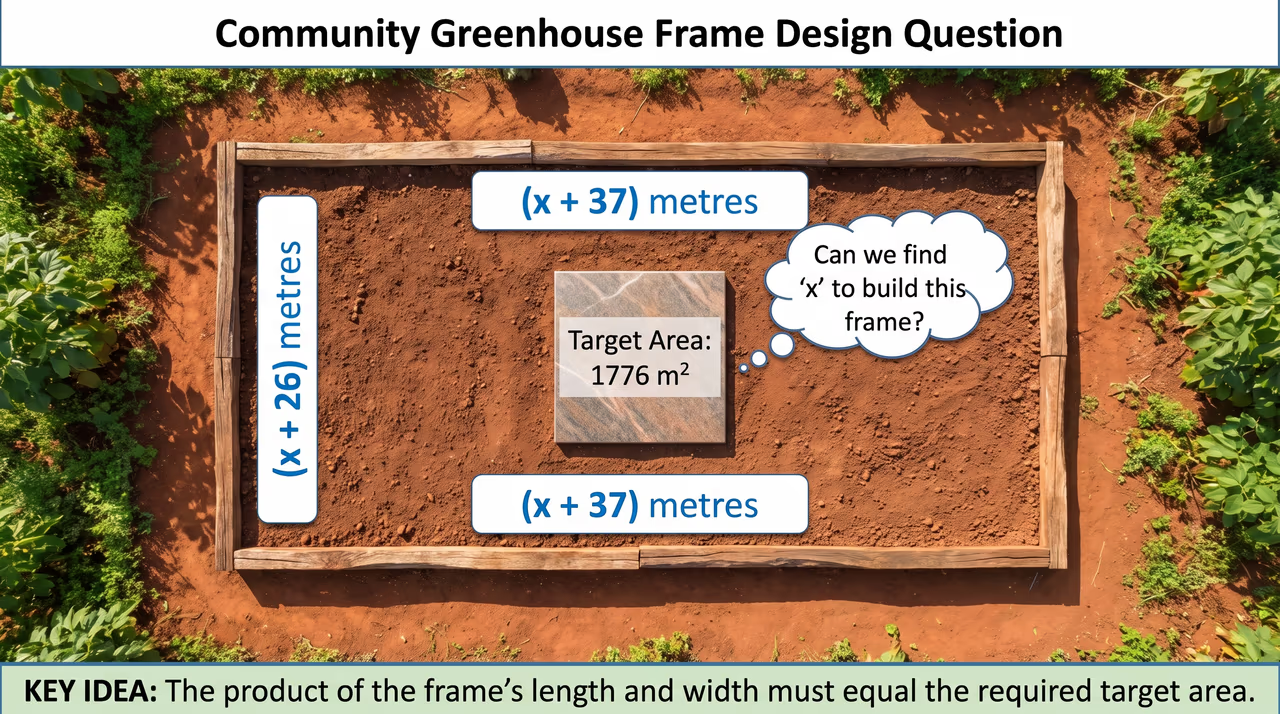
A rectangular greenhouse frame displaying its length and width as expressions of an unknown variable alongside a target area.
Figure 1: A rectangular greenhouse frame displaying its length and width as expressions of an unknown variable alongside a target area.

A community greenhouse bed has a rectangular frame with length x+37 metres and width x+26 metres. Its required area is 1776 square metres, so learners must turn the design condition into a quadratic model.

  • Define x as the variable width adjustment for the frame.
  • Write the two changing dimensions with metres attached.
  • Set the product of the dimensions equal to 1776.
  • Predict which algebraic root could describe a buildable frame.
Worked example. Let the length be x+37 metres and width x+26 metres. Set (x+37)(x+26)=1776. Expand to x²+63x+962=1776. Answer: The area model is (x+37)(x+26)=1776..

Check question: In the quadratic model (x+37)(x+26)=1776, what does the value 1776 represent?

  1. The required area of the greenhouse bed in square metres.
  2. The total perimeter of the greenhouse frame in metres.
  3. The volume of soil needed for the greenhouse bed in cubic metres.
  4. The value of the unknown variable x in metres.
Show answer

The required area of the greenhouse bed in square metres. The expression (x+37)(x+26) multiplies the length and width of the frame. The product of these two dimensions must meet the area constraint, which is 1776 square metres.

Slide 2 · Solve and filter the frame modelModel · 12 min
A mathematical board showing the discriminant and factor methods to find two roots, highlighting the positive value as acceptable.
Figure 2: A mathematical board showing the discriminant and factor methods to find two roots, highlighting the positive value as acceptable.

Teach the full lesson on the projector

This lesson, and every other Grade 1–10 CBE lesson, comes ready to project with the EAP ClassKit. It runs without electricity or internet.

  • All 4 slides with diagrams and class activities
  • Teacher notes, SNE adaptations and assessment checks
  • Homework and the other 13 lessons in this sub-strand

All 14 lessons in Quadratic Expressions and Equations

  1. 1Building Quadratic Expressions from DimensionsForm quadratic expressions from different situations
  2. 2Four Products on a NoticeboardForm quadratic expressions from different situations
  3. 3Deriving a Square Identity by AreaDerive the quadratic identities from the concept of area
  4. 4Restoring a Difference-Square AreaDerive the quadratic identities from the concept of area
  5. 5Nearby Bases for Mental SquaringApply quadratic identities in numerical cases
  6. 6Factor Pairs and GroupingFactorise quadratic expressions from different situations
  7. 7Forming an Area EquationForm quadratic equations in different situations
  8. 8A Consecutive-Integer EquationForm quadratic equations in different situations
  9. 9Solving by FactorisationSolve quadratic equations by factorisation
  10. 10Exact Roots with Signed FactorsSolve quadratic equations by factorisation
  11. 11A Triangular Sign ModelApply quadratic equations to real life situations
  12. 12Planning a Rectangular TankApply quadratic equations to real life situations
  13. 13Exploring Quadratic Models for a Community MuralExplore the use of quadratic equations in real life situations
  14. 14Exploring a Community Greenhouse FrameExplore the use of quadratic equations in real life situations