Skip to content

Grade 10 · Core Mathematics · Lesson 13 of 14

Exploring Quadratic Models for a Community Mural

A Grade 10 Core Mathematics CBE lesson from the sub-strand Quadratic Expressions and Equations. In it, learners investigate how a design constraint creates a quadratic.

Strand Numbers and AlgebraSub-strand Quadratic Expressions and EquationsLesson code 10CM-13-L1340 minutes · 4 slides

KICD learning outcome (h)

Explore the use of quadratic equations in real life situations.

By the end of this lesson, learners should be able to

  1. Investigate how a design constraint creates a quadratic.
  2. Compare models and feasible roots.
  3. Discuss modelling choices and share a justified conclusion.

Key vocabulary

Assumption
A stated choice about a situation that shapes a mathematical model.
The assumption is that the mural panel has one uniform width x.
Feasibility
The fit between a mathematical solution and the conditions of a real design.
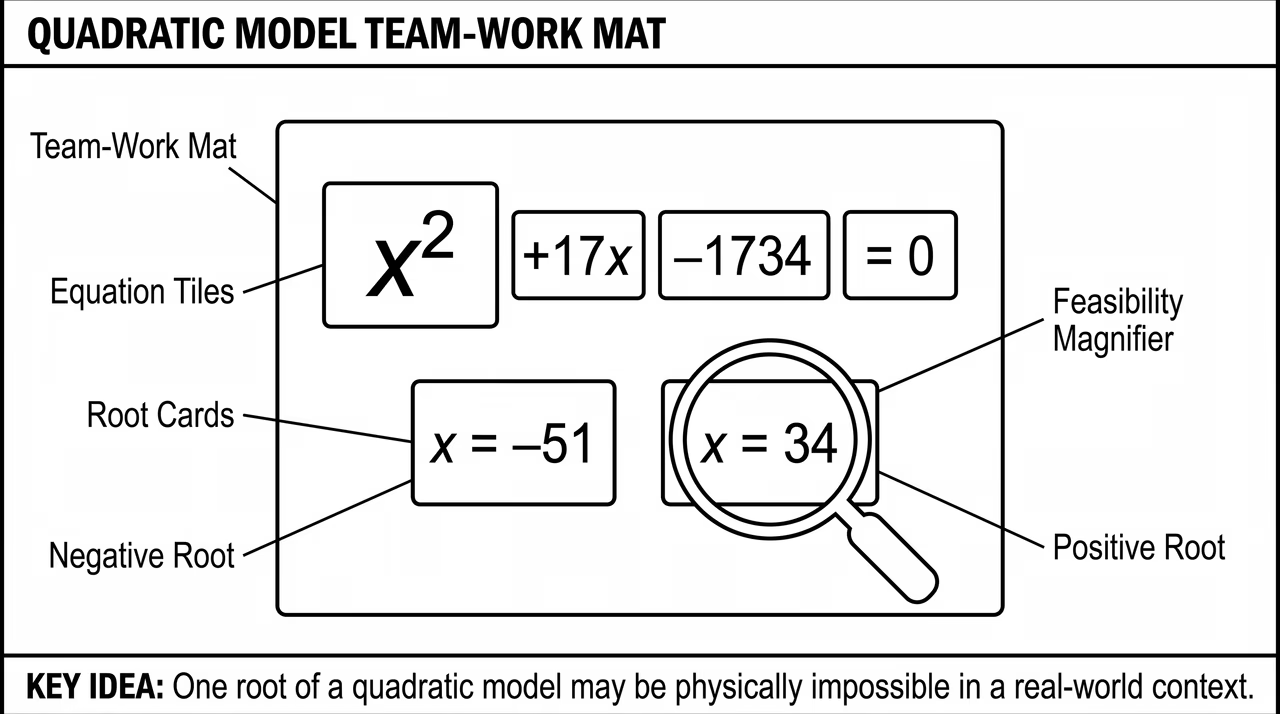
The positive width x=34 is feasible; x=−51 is not.
Comparison criterion
A stated measure used to judge two alternatives fairly.
Perimeter is a useful comparison criterion for the two mural designs.
Conclusion
A reasoned statement supported by results and stated criteria.
Our conclusion favours the rectangle because it gives 1734 m² despite the longer perimeter.

Lesson preview

Slide 1 · Pose a design questionOpening · 8 min
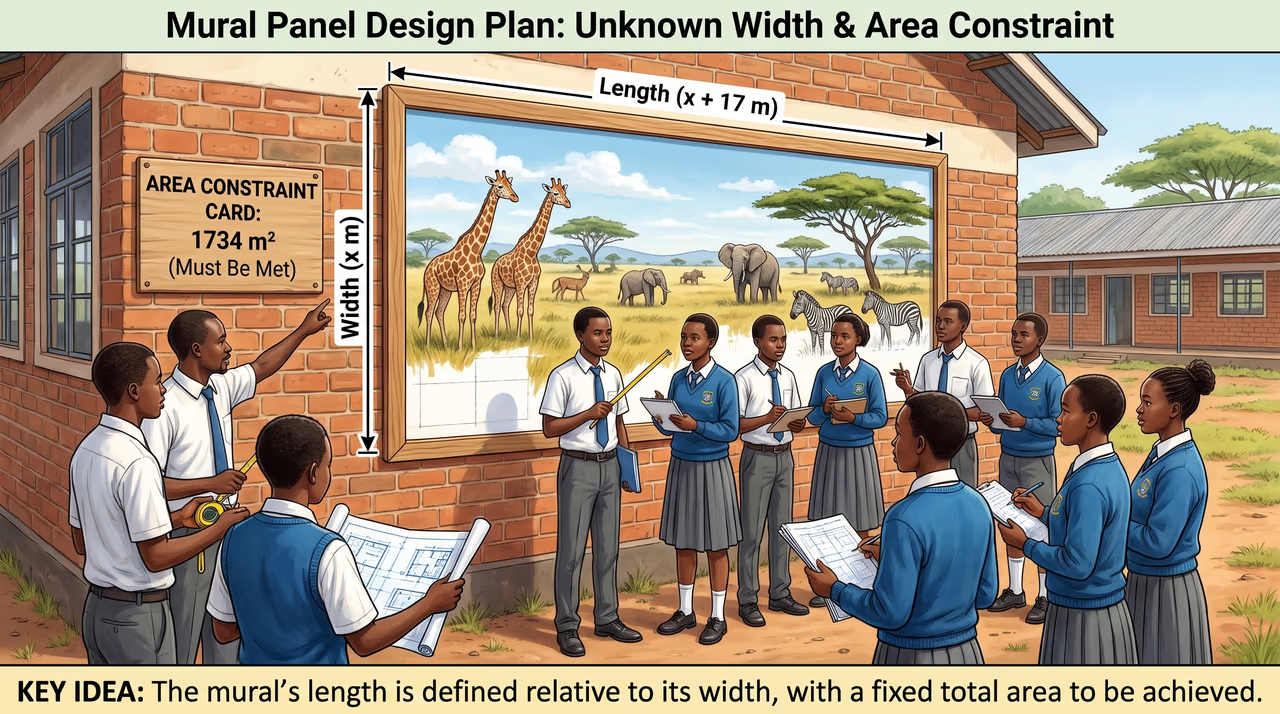
A group of students discusses a blank mural space on a brick wall, with labels showing its unknown dimensions and total area constraint.
Figure 1: A group of students discusses a blank mural space on a brick wall, with labels showing its unknown dimensions and total area constraint.

A community group wants a rectangular mural panel with area 1734 m², but the length is 17 m greater than the width. Learners first predict what information is needed and what a feasible solution should look like.

  • Define width x metres.
  • Represent length as x+17 metres.
  • Identify area as the constraint.
  • Predict why negative roots will need discussion.
Worked example. Let width be x metres. Length is x+17 metres. The constraint is x(x+17)=1734. Answer: The model is x(x+17)=1734..

Check question: When setting up the mathematical model for the community mural, which unknown quantity is initially represented by the variable x?

  1. The width of the panel in metres
  2. The length of the panel in metres
  3. The area of the panel in square metres
  4. The perimeter of the panel in metres
Show answer

The width of the panel in metres. The width is defined as x. The length is then expressed in terms of x as x+17, and the area is a given constraint of 1734 m2.

Slide 2 · Model and solve in teamsModel · 12 min
A team-work mat displays a quadratic equation alongside its two root cards, using a magnifier to highlight the physically feasible positive root.
Figure 2: A team-work mat displays a quadratic equation alongside its two root cards, using a magnifier to highlight the physically feasible positive root.

Teach the full lesson on the projector

This lesson, and every other Grade 1–10 CBE lesson, comes ready to project with the EAP ClassKit. It runs without electricity or internet.

  • All 4 slides with diagrams and class activities
  • Teacher notes, SNE adaptations and assessment checks
  • Homework and the other 13 lessons in this sub-strand

All 14 lessons in Quadratic Expressions and Equations

  1. 1Building Quadratic Expressions from DimensionsForm quadratic expressions from different situations
  2. 2Four Products on a NoticeboardForm quadratic expressions from different situations
  3. 3Deriving a Square Identity by AreaDerive the quadratic identities from the concept of area
  4. 4Restoring a Difference-Square AreaDerive the quadratic identities from the concept of area
  5. 5Nearby Bases for Mental SquaringApply quadratic identities in numerical cases
  6. 6Factor Pairs and GroupingFactorise quadratic expressions from different situations
  7. 7Forming an Area EquationForm quadratic equations in different situations
  8. 8A Consecutive-Integer EquationForm quadratic equations in different situations
  9. 9Solving by FactorisationSolve quadratic equations by factorisation
  10. 10Exact Roots with Signed FactorsSolve quadratic equations by factorisation
  11. 11A Triangular Sign ModelApply quadratic equations to real life situations
  12. 12Planning a Rectangular TankApply quadratic equations to real life situations
  13. 13Exploring Quadratic Models for a Community MuralExplore the use of quadratic equations in real life situations
  14. 14Exploring a Community Greenhouse FrameExplore the use of quadratic equations in real life situations