
Skip to content

Grade 10 · Core Mathematics · Lesson 1 of 14

Building Quadratic Expressions from Dimensions

A Grade 10 Core Mathematics CBE lesson from the sub-strand Quadratic Expressions and Equations. In it, learners represent dimensions with a variable and constants.

Strand Numbers and AlgebraSub-strand Quadratic Expressions and EquationsLesson code 10CM-13-L140 minutes · 3 slides

KICD learning outcome (a)

Form quadratic expressions from different situations.

By the end of this lesson, learners should be able to

  1. Represent dimensions with a variable and constants.
  2. Multiply two linear expressions using distribution.
  3. Collect like terms into a quadratic expression.

Key vocabulary

Variable
A symbol that stands for a changing or unknown quantity.
Let x represent the adjustable garden length in metres.
Distribution
Multiplication applied to every addend inside a bracket.
Distribution sends 4x across both terms in x+13.
Constant term
The term with no variable in a polynomial.
In (x+23)(x+31), the constant term is 23×31=713.

Lesson preview

Slide 1 · Read dimensions as algebraOpening · 10 min
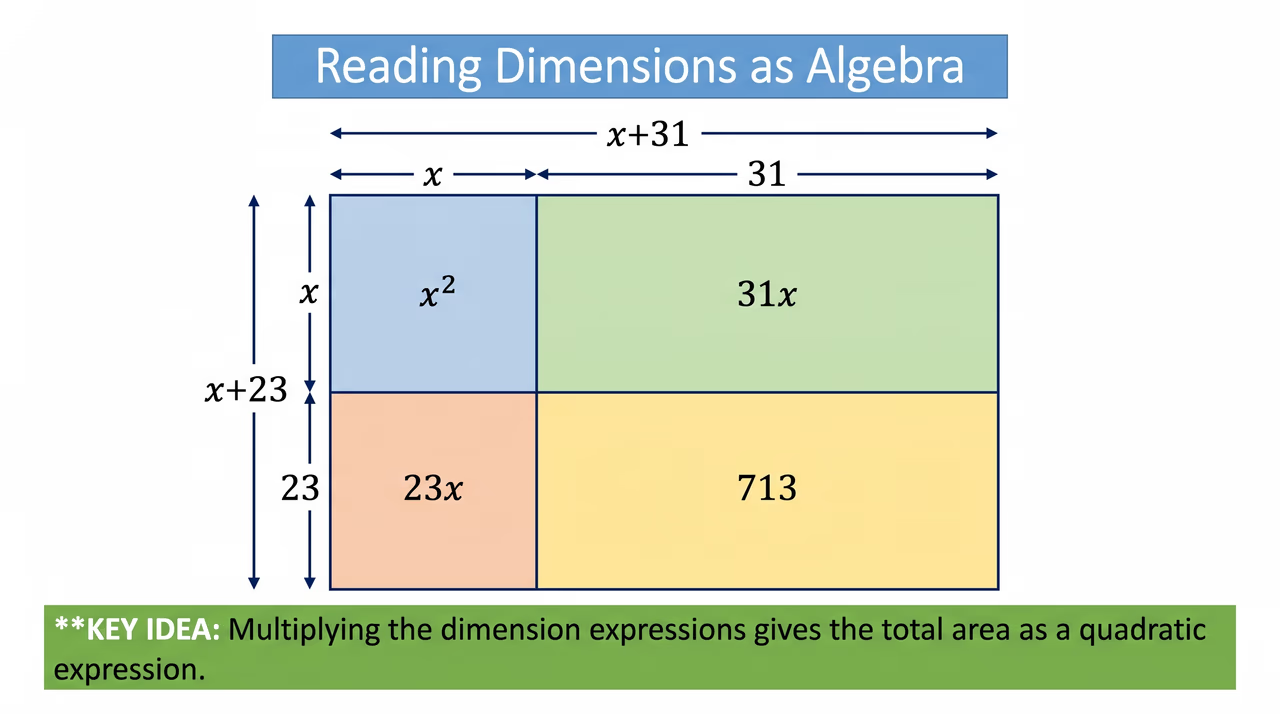
A rectangular area model divided into four sections, showing how multiplying dimension expressions gives a total quadratic area.
Figure 1: A rectangular area model divided into four sections, showing how multiplying dimension expressions gives a total quadratic area.

A rectangle can represent a practical area while one side changes. Naming that side x lets the second side and the total area remain symbolic.

  • Choose one variable for the changing length.
  • Write both sides before multiplying.
  • Use square units for area.
  • Keep terms connected to their regions.
Worked example. Multiply x by x to obtain x². The strips are 31x and 23x. The corner is 23×31=713. Answer: The area is x²+54x+713..

Check question: A rectangular farm plot has a length of (x+10) metres and a width of (x+5) metres. Which expression represents the initial setup to find its total area in square metres?

  1. (x+10)+(x+5)
  2. 2(x+10)+2(x+5)
  3. (x+10)(x+5)
  4. x2+50
Show answer

(x+10)(x+5). The area of a rectangle is calculated by multiplying its length by its width. Therefore, we must multiply the entire expression for the length, (x+10), by the entire expression for the width, (x+5), to form (x+10)(x+5).

Slide 2 · Distribute every termModel · 18 min
An area model with arrows that demonstrate how each term on one side multiplies by each term on the other side.
Figure 2: An area model with arrows that demonstrate how each term on one side multiplies by each term on the other side.

Teach the full lesson on the projector

This lesson, and every other Grade 1–10 CBE lesson, comes ready to project with the EAP ClassKit. It runs without electricity or internet.

  • All 3 slides with diagrams and class activities
  • Teacher notes, SNE adaptations and assessment checks
  • Homework and the other 13 lessons in this sub-strand

All 14 lessons in Quadratic Expressions and Equations

  1. 1Building Quadratic Expressions from DimensionsForm quadratic expressions from different situations
  2. 2Four Products on a NoticeboardForm quadratic expressions from different situations
  3. 3Deriving a Square Identity by AreaDerive the quadratic identities from the concept of area
  4. 4Restoring a Difference-Square AreaDerive the quadratic identities from the concept of area
  5. 5Nearby Bases for Mental SquaringApply quadratic identities in numerical cases
  6. 6Factor Pairs and GroupingFactorise quadratic expressions from different situations
  7. 7Forming an Area EquationForm quadratic equations in different situations
  8. 8A Consecutive-Integer EquationForm quadratic equations in different situations
  9. 9Solving by FactorisationSolve quadratic equations by factorisation
  10. 10Exact Roots with Signed FactorsSolve quadratic equations by factorisation
  11. 11A Triangular Sign ModelApply quadratic equations to real life situations
  12. 12Planning a Rectangular TankApply quadratic equations to real life situations
  13. 13Exploring Quadratic Models for a Community MuralExplore the use of quadratic equations in real life situations
  14. 14Exploring a Community Greenhouse FrameExplore the use of quadratic equations in real life situations