
Grade 10 · Core Mathematics · Lesson 2 of 14
Four Products on a Noticeboard
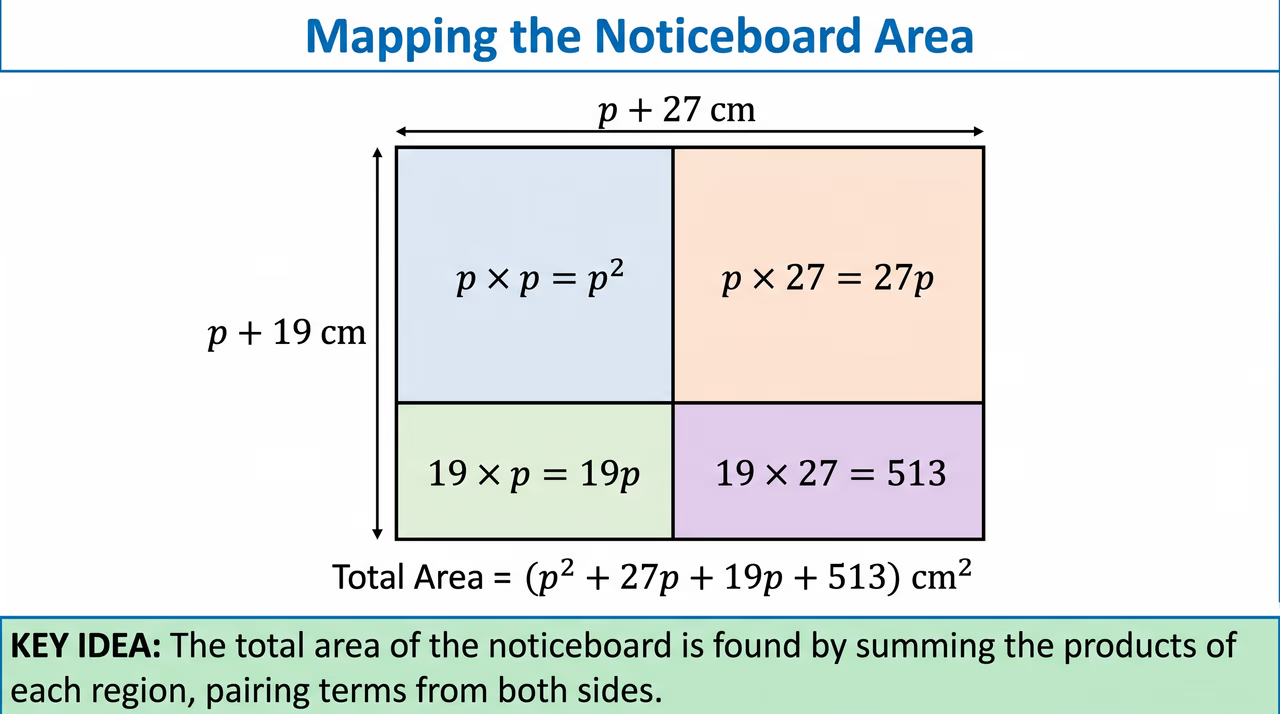
A Grade 10 Core Mathematics CBE lesson from the sub-strand Quadratic Expressions and Equations. In it, learners map four products from two binomials.
Strand Numbers and AlgebraSub-strand Quadratic Expressions and EquationsLesson code 10CM-13-L240 minutes · 3 slides
KICD learning outcome (a)
Form quadratic expressions from different situations.
By the end of this lesson, learners should be able to
- Map four products from two binomials.
- Collect like terms with clear notation.
- Verify an area expression by substitution.
Key vocabulary
- Binomial
- An algebraic expression made from two terms joined by addition or subtraction.
- The side p+19 is a binomial with variable and constant terms.
- Coefficient
- A numerical factor multiplying a variable or its power.
- In 46p, the coefficient of p is 46.
- Verification
- A check that two equivalent representations give the same result.
- At p=2, compare 21×29 with 4+92+513.
Lesson preview

All 14 lessons in Quadratic Expressions and Equations
- 1Building Quadratic Expressions from DimensionsForm quadratic expressions from different situations
- 2Four Products on a NoticeboardForm quadratic expressions from different situations
- 3Deriving a Square Identity by AreaDerive the quadratic identities from the concept of area
- 4Restoring a Difference-Square AreaDerive the quadratic identities from the concept of area
- 5Nearby Bases for Mental SquaringApply quadratic identities in numerical cases
- 6Factor Pairs and GroupingFactorise quadratic expressions from different situations
- 7Forming an Area EquationForm quadratic equations in different situations
- 8A Consecutive-Integer EquationForm quadratic equations in different situations
- 9Solving by FactorisationSolve quadratic equations by factorisation
- 10Exact Roots with Signed FactorsSolve quadratic equations by factorisation
- 11A Triangular Sign ModelApply quadratic equations to real life situations
- 12Planning a Rectangular TankApply quadratic equations to real life situations
- 13Exploring Quadratic Models for a Community MuralExplore the use of quadratic equations in real life situations
- 14Exploring a Community Greenhouse FrameExplore the use of quadratic equations in real life situations