
Skip to content

Grade 10 · Core Mathematics · Lesson 3 of 11

Determining Trigonometric Ratios from Tables and Calculators

A Grade 10 Core Mathematics CBE lesson from the sub-strand Trigonometry 1. In it, learners read tangent values of acute angles up to two decimal places from four-figure mathematical tables using the ADD mean difference column.

Strand Measurements and GeometrySub-strand Trigonometry 1Lesson code 10CM-24-L340 minutes · 4 slides

KICD learning outcome (a)

Determine the trigonometric ratios of acute angles from mathematical tables and calculators.

By the end of this lesson, learners should be able to

  1. Read tangent values of acute angles up to two decimal places from four-figure mathematical tables using the ADD mean difference column.
  2. Evaluate sine, cosine, and tangent ratios of acute angles using a scientific calculator in degree mode.
  3. Compare trigonometric table values with scientific calculator outputs to round results accurately to four decimal places.

Key vocabulary

Natural tangent
The trigonometric ratio of the opposite side to the adjacent side in a right-angled triangle.
We read the natural tangent of forty-two degrees from four-figure mathematical tables.
Mean difference
A small value in additional columns added to or subtracted from table readings.
We add a mean difference of twenty to find tangent of fifty-three point two four.
Degree mode
A calculator setting ensuring trigonometric function inputs are interpreted in angular degrees.
Set the calculator to degree mode before finding sine of fifty-four point three six.

Lesson preview

Slide 1 · Reading Tangents of Acute Angles from Four-Figure TablesOpening · 10 min
A section of a four-figure mathematical table showing natural tangents for angles between 10 and 13 degrees.
Figure 1: A section of a four-figure mathematical table showing natural tangents for angles between 10 and 13 degrees.

Four-figure mathematical tables of natural tangents allow us to determine the ratio of the opposite side to the adjacent side for any acute angle. Whole degree values are located in the main vertical column x, while tenths of a degree appear across the top main columns 0.0∘ to 0.9∘. For hundredths of a degree, we look under the ADD column for the required digit and add the mean difference to the last digits of the base reading. Use Figure 1 to see how tangent values are organised into columns for tenths of a degree.

  • Tangent tables give values for acute angles stated to two decimal places.
  • Whole degree angles are located in the left column x.
  • Tenths of a degree are read from main columns 0.0 to 0.9.
  • Hundredths of a degree are located in ADD columns and added to main readings.
Worked example. Locate row 42∘ down the column headed x. Move across row 42∘ to the main column headed 0.3∘. Read the number at the intersection: 0.9099. Answer: tan⁡42.3∘=0.9099.

Check question: What value is read from the tangent table at the intersection of row 28∘ and main column 0.7∘?

  1. 0.5317
  2. 0.5452
  3. 0.5475
  4. 0.5498
Show answer

0.5475. Locating row 28∘ and moving across to column 0.7∘ gives 0.5475.

Slide 2 · Finding Tangents with Mean DifferencesModel · 10 min
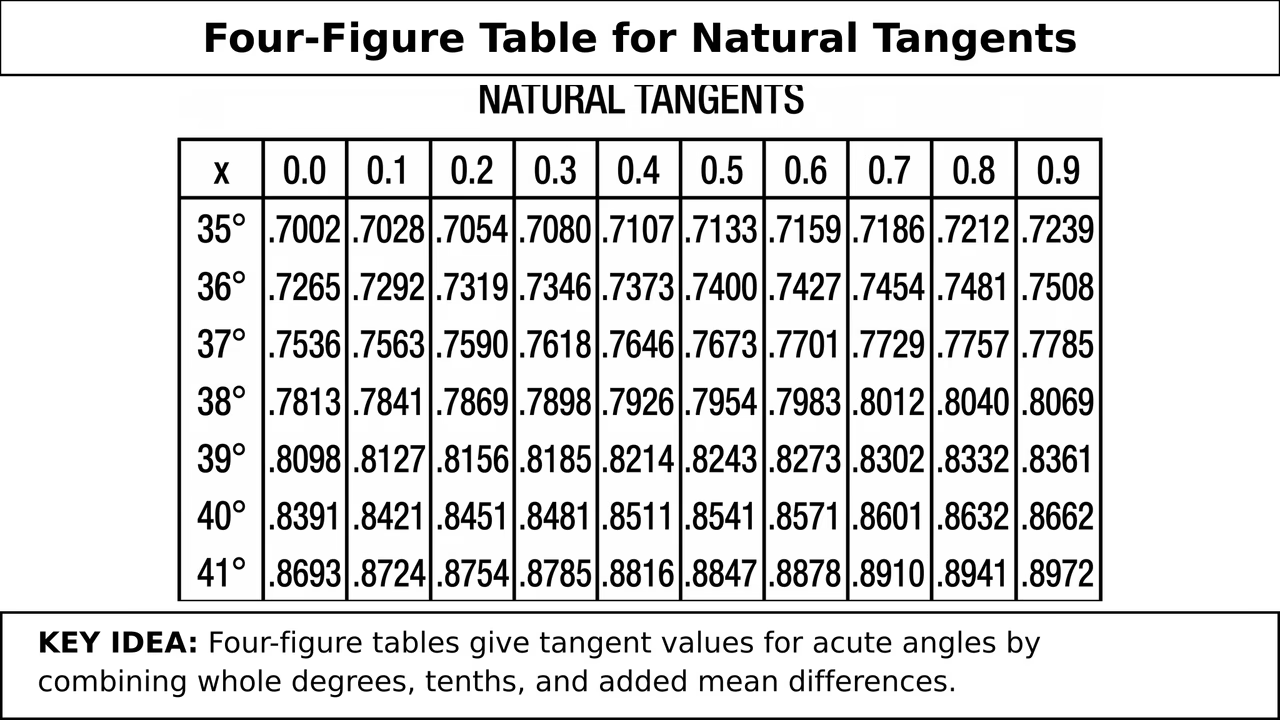
An excerpt from a tangent table demonstrating how to use the mean difference column to find the tangent of 37.48 degrees.
Figure 2: An excerpt from a tangent table demonstrating how to use the mean difference column to find the tangent of 37.48 degrees.

Teach the full lesson on the projector

This lesson, and every other Grade 1–10 CBE lesson, comes ready to project with the EAP ClassKit. It runs without electricity or internet.

  • All 4 slides with diagrams and class activities
  • Teacher notes, SNE adaptations and assessment checks
  • Homework and the other 10 lessons in this sub-strand

All 11 lessons in Trigonometry 1

  1. 1Reading Sines and Cosines from Mathematical TablesDetermine the trigonometric ratios of acute angles from mathematical tables and calculators
  2. 2Finding Cosine and Tangent Values of Acute AnglesDetermine the trigonometric ratios of acute angles from mathematical tables and calculators
  3. 3Determining Trigonometric Ratios from Tables and CalculatorsDetermine the trigonometric ratios of acute angles from mathematical tables and calculators
  4. 4Connecting Sine and Cosine in Complementary AnglesRelate sines and cosines of complementary angles
  5. 5Solving Trigonometric Equations with Complementary AnglesRelate sines and cosines of complementary angles
  6. 6Relating Sine, Cosine, and TangentRelate the sine, cosine and tangent of acute angles
  7. 7Trigonometric Ratios of Special Angles: 30° and 60°Determine trigonometric ratios of special angles: 30°, 45°, 60° and 90° using triangles
  8. 8Trigonometric Ratios of Special Angles: 45° and 90°Determine trigonometric ratios of special angles: 30°, 45°, 60° and 90° using triangles
  9. 9Application of Trigonometric Ratios to Angles of Elevation and DepressionApply trigonometric ratios to angles of elevation and depression
  10. 10Applying Trigonometric Ratios to Angles of Elevation and DepressionApply trigonometric ratios to angles of elevation and depression
  11. 11Reflecting on Real-Life Applications of TrigonometryReflect on the use of trigonometry in real-life situations