Skip to content

Grade 10 · Core Mathematics · Lesson 2 of 11

Finding Cosine and Tangent Values of Acute Angles

A Grade 10 Core Mathematics CBE lesson from the sub-strand Trigonometry 1. In it, learners locate acute angles in cosine tables and read four-figure cosine values for whole and decimal degrees.

Strand Measurements and GeometrySub-strand Trigonometry 1Lesson code 10CM-24-L240 minutes · 4 slides

KICD learning outcome (a)

Determine the trigonometric ratios of acute angles from mathematical tables and calculators.

By the end of this lesson, learners should be able to

  1. Locate acute angles in cosine tables and read four-figure cosine values for whole and decimal degrees.
  2. Apply mean difference subtraction correctly when evaluating cosines of angles given to two decimal places.
  3. Locate acute angles in tangent tables and apply mean difference addition for two-decimal-place angles.

Key vocabulary

Cosine table
A mathematical grid giving cosine values of acute angles up to four decimal places.
We look up row 51° in the cosine table to find initial ratio values.
Subtract column
The difference columns in cosine tables used to subtract mean differences for hundredths.
We locate column 4 in the subtract section to adjust the cosine ratio.
Mean difference
A tabular adjustment representing hundredths of a degree added or subtracted from readings.
A mean difference of 8 is subtracted when evaluating cos 61.45° as 0.4779.
Natural tangent
The trigonometric ratio comparing opposite side length to adjacent side length.
The natural tangent of 36.4° is read from tangent tables as 0.7373.

Lesson preview

Slide 1 · Introduction to Cosine TablesOpening · 10 min
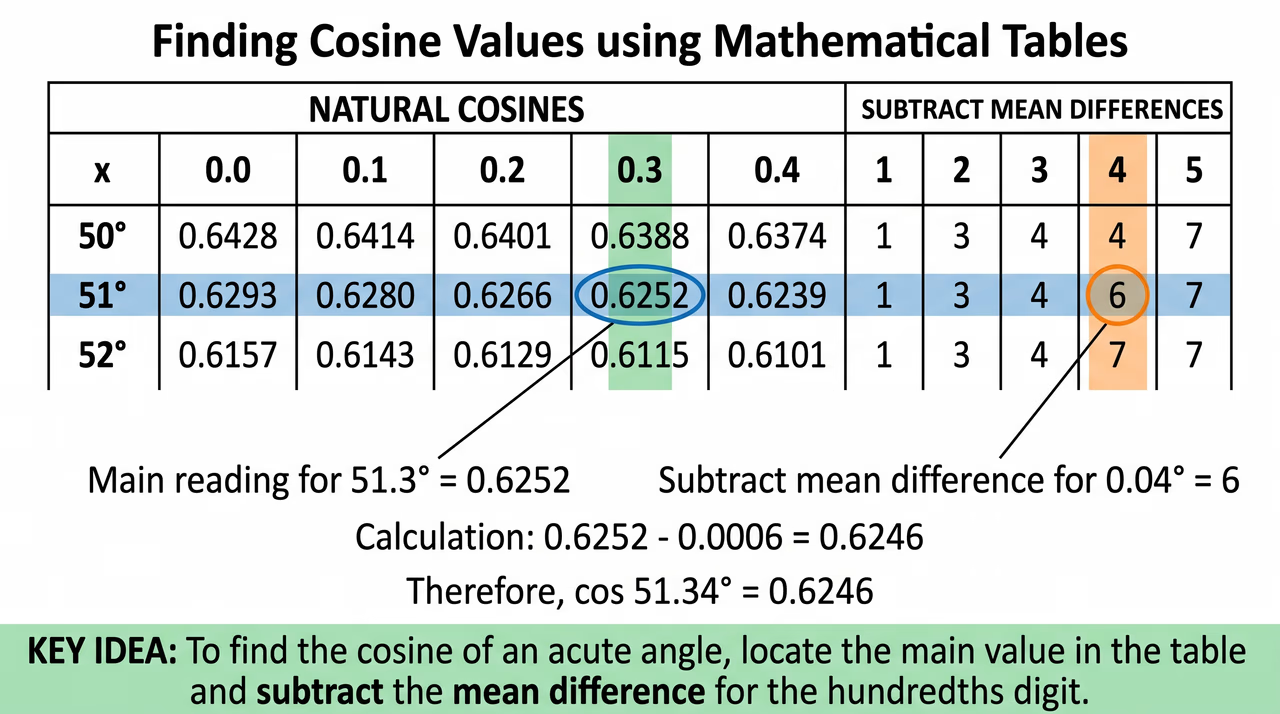
A segment of a natural cosines table showing how to find the cosine of 51.34 degrees.
Figure 1: A segment of a natural cosines table showing how to find the cosine of 51.34 degrees.

To evaluate an angle such as cos⁡(51.34∘), consider how cosine tables are arranged. Locate row 51∘ under column x and move across to column 0.3. Note the four-figure number at this primary intersection. Next, move along the same row to column 4 under the SUBTRACT section for the mean difference. Subtract this value from the final digit position of the main reading to get the complete four-figure cosine ratio. Use Figure 1 to follow this process for finding the cosine of 51.34 degrees.

  • Cosine decreases as acute angles increase, so mean differences must always be subtracted.
  • Locate whole-degree angles down column x and first decimal digits along top main columns.
  • Read the main intersection value before checking the hundredths digit in difference columns.
  • Subtract the mean difference digit from the final position of the main table reading.
Worked example. Locate row 54∘ down column x and move across to column 0.6 to read 0.5793. Move along row 54∘ to difference column 3 under SUBTRACT to find mean difference 4. Subtract 0.0004 from 0.5793 to obtain 0.5789. Answer: cos⁡(54.63∘)=0.5789.

Check question: Determine cos⁡(61.45∘) using cosine tables, given that row 61∘ under column 0.4 gives 0.4787 and SUBTRACT column 5 gives 8.

  1. 0.4779
  2. 0.4795
  3. 0.4707
  4. 0.3987
Show answer

0.4779. The value from the main intersection is 0.4787. The mean difference of 8 means 0.0008. Since cosine values decrease as the angle increases, we subtract the mean difference: 0.4787−0.0008=0.4779.

Slide 2 · Modelling Cosine Table Lookups with Decimal AnglesModel · 10 min
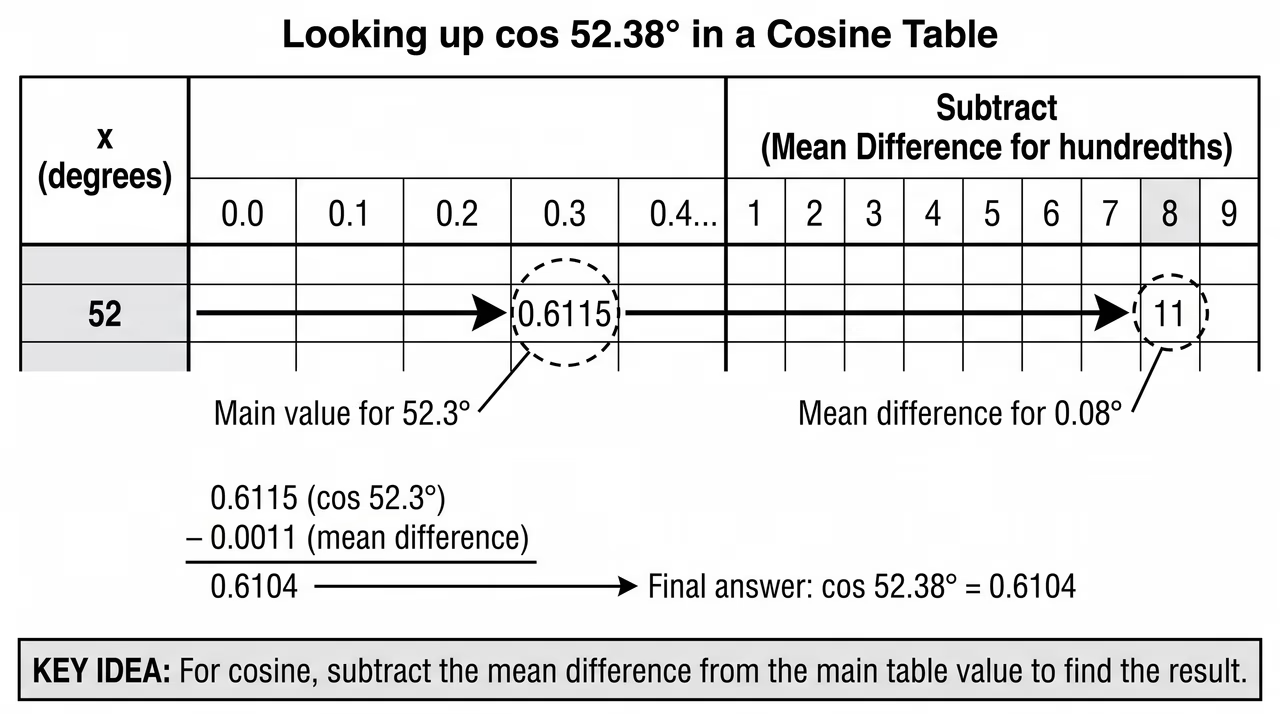
A diagram illustrating the steps to find the cosine of 52.38 degrees using a mathematical table.
Figure 2: A diagram illustrating the steps to find the cosine of 52.38 degrees using a mathematical table.

Teach the full lesson on the projector

This lesson, and every other Grade 1–10 CBE lesson, comes ready to project with the EAP ClassKit. It runs without electricity or internet.

  • All 4 slides with diagrams and class activities
  • Teacher notes, SNE adaptations and assessment checks
  • Homework and the other 10 lessons in this sub-strand

All 11 lessons in Trigonometry 1

  1. 1Reading Sines and Cosines from Mathematical TablesDetermine the trigonometric ratios of acute angles from mathematical tables and calculators
  2. 2Finding Cosine and Tangent Values of Acute AnglesDetermine the trigonometric ratios of acute angles from mathematical tables and calculators
  3. 3Determining Trigonometric Ratios from Tables and CalculatorsDetermine the trigonometric ratios of acute angles from mathematical tables and calculators
  4. 4Connecting Sine and Cosine in Complementary AnglesRelate sines and cosines of complementary angles
  5. 5Solving Trigonometric Equations with Complementary AnglesRelate sines and cosines of complementary angles
  6. 6Relating Sine, Cosine, and TangentRelate the sine, cosine and tangent of acute angles
  7. 7Trigonometric Ratios of Special Angles: 30° and 60°Determine trigonometric ratios of special angles: 30°, 45°, 60° and 90° using triangles
  8. 8Trigonometric Ratios of Special Angles: 45° and 90°Determine trigonometric ratios of special angles: 30°, 45°, 60° and 90° using triangles
  9. 9Application of Trigonometric Ratios to Angles of Elevation and DepressionApply trigonometric ratios to angles of elevation and depression
  10. 10Applying Trigonometric Ratios to Angles of Elevation and DepressionApply trigonometric ratios to angles of elevation and depression
  11. 11Reflecting on Real-Life Applications of TrigonometryReflect on the use of trigonometry in real-life situations