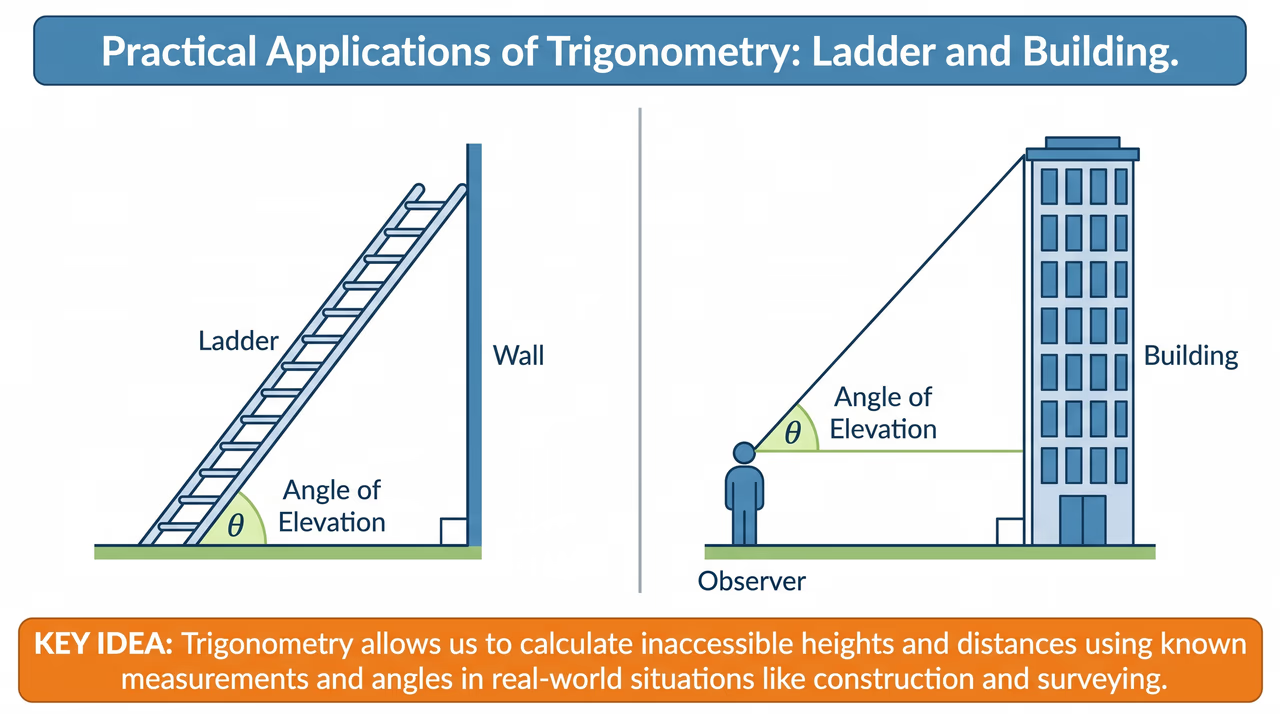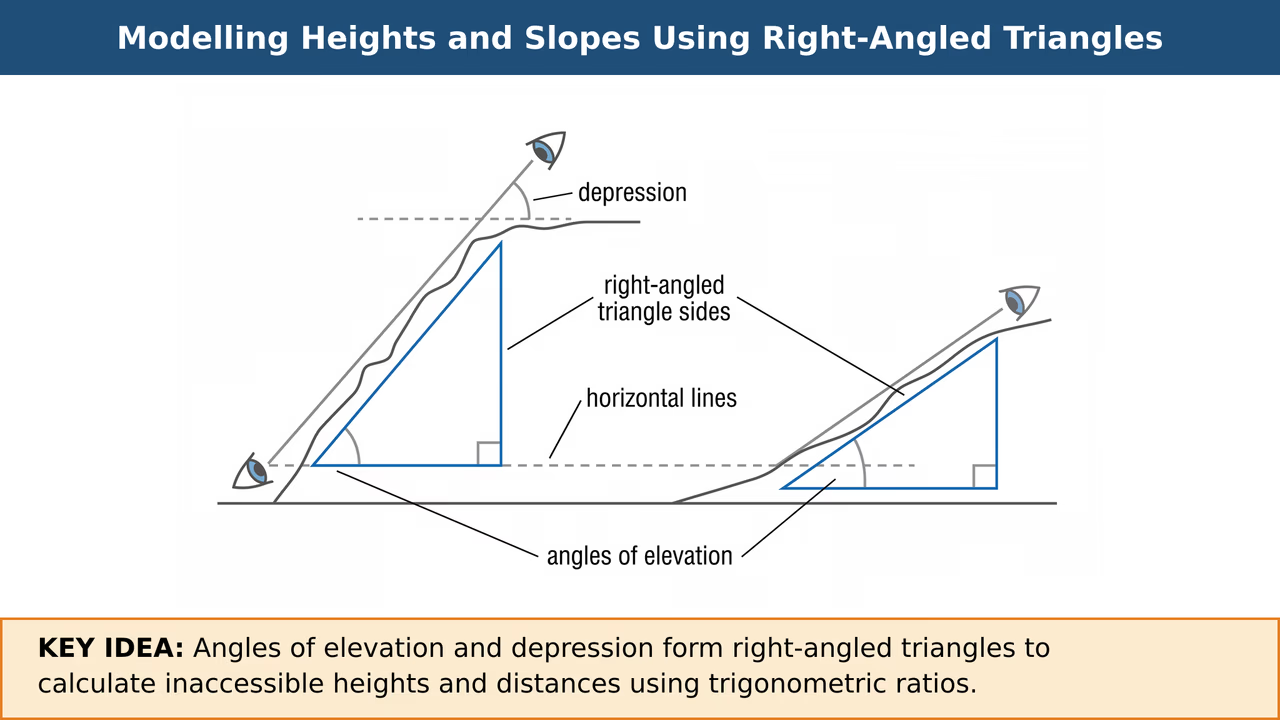
Angles of elevation and depression allow us to measure inaccessible heights and distances by framing them as right-angled triangles. By identifying known sides or angles, appropriate trigonometric ratios like sine, cosine, or tangent can be selected to solve real-world problems. Whether calculating the slope of a road climbing a hill or determining how far a vessel is from a cliff, trigonometry converts physical observations into accurate geometric calculations. Use Figure 1 to see how to frame these hill and cliff scenarios as right-angled triangles.
- The angle of elevation and depression can be applied to solve unknown distances and heights in real situations.
- Identifying opposite, adjacent, and hypotenuse sides determines whether to use sine, cosine, or tangent ratios.
- Calculating road slope angles on hills requires comparing vertical elevation change with total incline distance.
- The angle of depression from a cliff top equals the angle of elevation from the observed object.
Check question: A lookout atop a vertical cliff high observes a ferry at an angle of depression of . Calculate the horizontal distance of the ferry from the base of the cliff to 2 decimal places.
Show answer
. The angle of depression is , which means the alternate interior angle (the angle of elevation from the ferry to the top of the cliff) is also . Using the tangent ratio: . Rearranging to solve for the horizontal distance , we get .