
Skip to content

Grade 10 · Core Mathematics · Lesson 8 of 12

Area of Common Region Between Two Intersecting Circles

A Grade 10 Core Mathematics CBE lesson from the sub-strand Area of a Part of a Circle. In it, learners identify the common chord and the two circular segments forming the region of intersection between two circles.

Strand Measurements and GeometrySub-strand Area of a Part of a CircleLesson code 10CM-26-L840 minutes · 2 slides

KICD learning outcome (e)

Determine the area of common region between two intersecting circles.

By the end of this lesson, learners should be able to

  1. Identify the common chord and the two circular segments forming the region of intersection between two circles.
  2. Calculate the area of intersection between two circles by summing the areas of the respective segments.

Key vocabulary

Common Chord
A line segment connecting the two intersection points shared by two overlapping circles.
The common chord AB divides the overlapping area into two distinct circular segments.
Area of Intersection
The total surface area of the common region shared between two overlapping shapes.
The area of intersection equals the sum of the two circular segments on AB.

Lesson preview

Slide 1 · Understanding Intersecting Circles and Common ChordsModel · 18 min
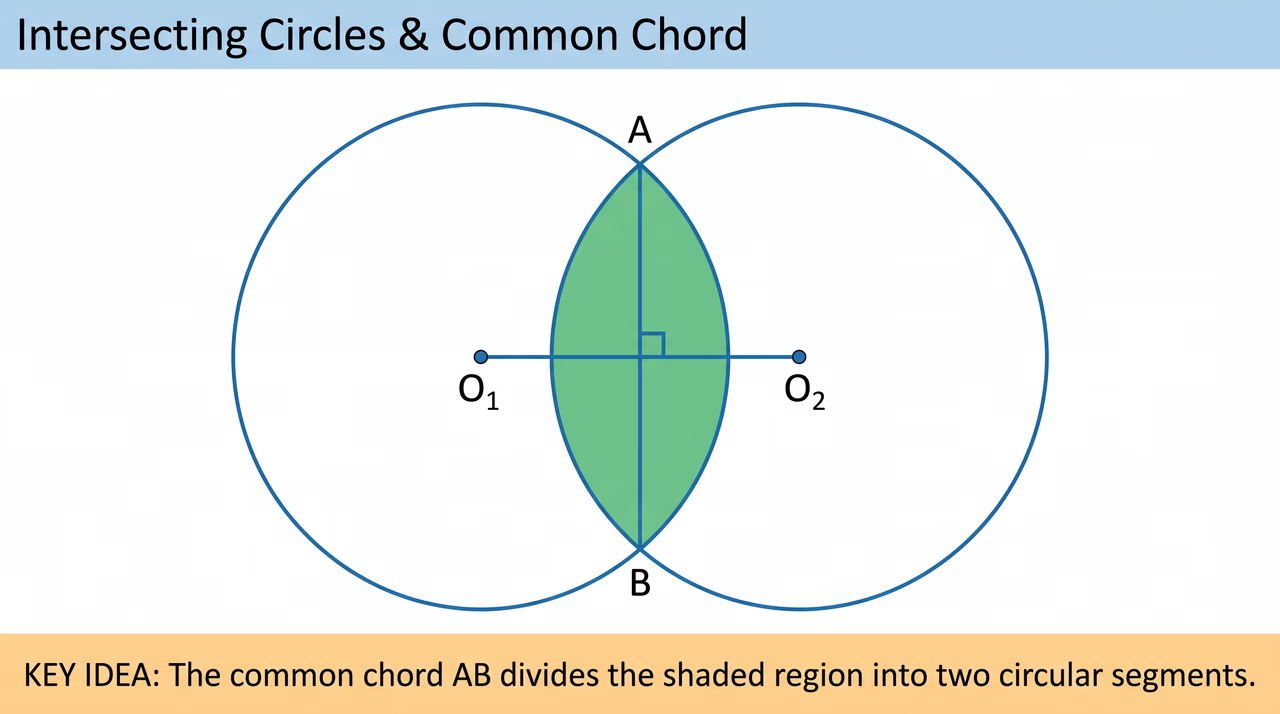
Two intersecting circles showing a common chord that divides the shaded overlapping region into two segments.
Figure 1: Two intersecting circles showing a common chord that divides the shaded overlapping region into two segments.

When two circles with centres O1 and O2 intersect at points A and B, the line segment AB is their common chord. This common chord divides the region of overlap into two circular segments: one belonging to the circle with centre O1, and the other to the circle with centre O2. To determine the area of the common region, we calculate the area of each circular segment independently using sector and triangle formulae, then add the two segment areas together.

  • Two intersecting circles with centres O1 and O2 meet at two points A and B.
  • The line segment connecting intersection points A and B is called their common chord.
  • The common region shared by both circles is split into two circular segments by the common chord.
  • Adding the area of the segment from the first circle to the area of the segment from the second circle gives the total area of intersection.
Worked example. Identify the common region as the sum of two identical circular segments on chord AB. Calculate the area of sector AO1B: 90∘360∘×3.142×122=0.25×3.142×144=113.112 cm2. Calculate the area of triangle AO1B: 12×12×12×sin⁡90∘=72 cm2. Find the area of segment 1: 113.112−72=41.112 cm2. Since the second circle is identical, segment 2 area is also 41.112 cm2. Sum the two segment areas: 41.112+41.112=82.224 cm2. Answer: 82.22 cm2.

Check question: Two overlapping circular floral beds with centres O1 and O2 each have a radius of 10 m. The angle subtended by their common chord AB at each centre is 90∘. Calculate the total area of the common region. (Take π=3.142)

  1. 28.55 m2
  2. 57.10 m2
  3. 157.10 m2
  4. 257.10 m2
Show answer

57.10 m2. For one floral bed, the sector area is 90∘360∘×3.142×102=78.55 m2. The area of the triangle is 12×10×10×sin⁡90∘=50 m2. The area of one circular segment is 78.55−50=28.55 m2. Since the two floral beds are identical, the total area of the common region is 2×28.55=57.10 m2.

Slide 2 · Calculating the Area of Intersection for Non-Identical CirclesPractice · 22 min
Two non-identical intersecting circles with their radii, central angles, and a common chord dividing the shaded area.
Figure 2: Two non-identical intersecting circles with their radii, central angles, and a common chord dividing the shaded area.

Teach the full lesson on the projector

This lesson, and every other Grade 1–10 CBE lesson, comes ready to project with the EAP ClassKit. It runs without electricity or internet.

  • Both slides with diagrams and class activities
  • Teacher notes, SNE adaptations and assessment checks
  • Homework and the other 11 lessons in this sub-strand

All 12 lessons in Area of a Part of a Circle

  1. 1Area of an AnnulusDetermine the area of an annulus in different situations
  2. 2Area of an Annulus in Applied ContextsDetermine the area of an annulus in different situations
  3. 3Area of a Sector of a Circle in Real-Life SituationsWork out the area of a sector of a circle in real-life situations
  4. 4Area of a Sector of a Circle in Real-Life SituationsWork out the area of a sector of a circle in real-life situations
  5. 5Area of an Annular SectorDetermine the area of an annular sector in different situations
  6. 6Area of a Segment of a CircleWork out the area of a segment of a circle
  7. 7Area of a Segment of a Circle in ContextWork out the area of a segment of a circle
  8. 8Area of Common Region Between Two Intersecting CirclesDetermine the area of common region between two intersecting circles
  9. 9Applications of Area of Parts of a CircleApply the area of a part of a circle in real-life situations
  10. 10Applying Area of Parts of a Circle in Real-Life SituationsApply the area of a part of a circle in real-life situations
  11. 11Exploring the Area of a Sector in Real-Life ContextsExplore the use of the area of a part of a circle in real-life situations
  12. 12Applications of Area of a Part of a CircleExplore the use of the area of a part of a circle in real-life situations