Skip to content

Grade 10 · Core Mathematics · Lesson 11 of 12

Exploring the Area of a Sector in Real-Life Contexts

A Grade 10 Core Mathematics CBE lesson from the sub-strand Area of a Part of a Circle. In it, learners derive the formula for the area of a circular sector using central angles and area ratios.

Strand Measurements and GeometrySub-strand Area of a Part of a CircleLesson code 10CM-26-L1140 minutes · 2 slides

KICD learning outcome (g)

Explore the use of the area of a part of a circle in real-life situations.

By the end of this lesson, learners should be able to

  1. Derive the formula for the area of a circular sector using central angles and area ratios.
  2. Calculate the area of circular sectors in practical real-life scenarios such as umbrella panels.

Key vocabulary

Sector
A region of a circle bounded by two radii and the connecting arc.
A sector with a central angle of 90° covers one-fourth of the total circle area.
Quadrant
A quarter of a circle formed by two perpendicular radii subtending a 90° angle.
Folding a circular paper into four equal quadrants creates sectors subtending 90° each.
Subtending
Forming or extending opposite to a specific central angle or arc in geometry.
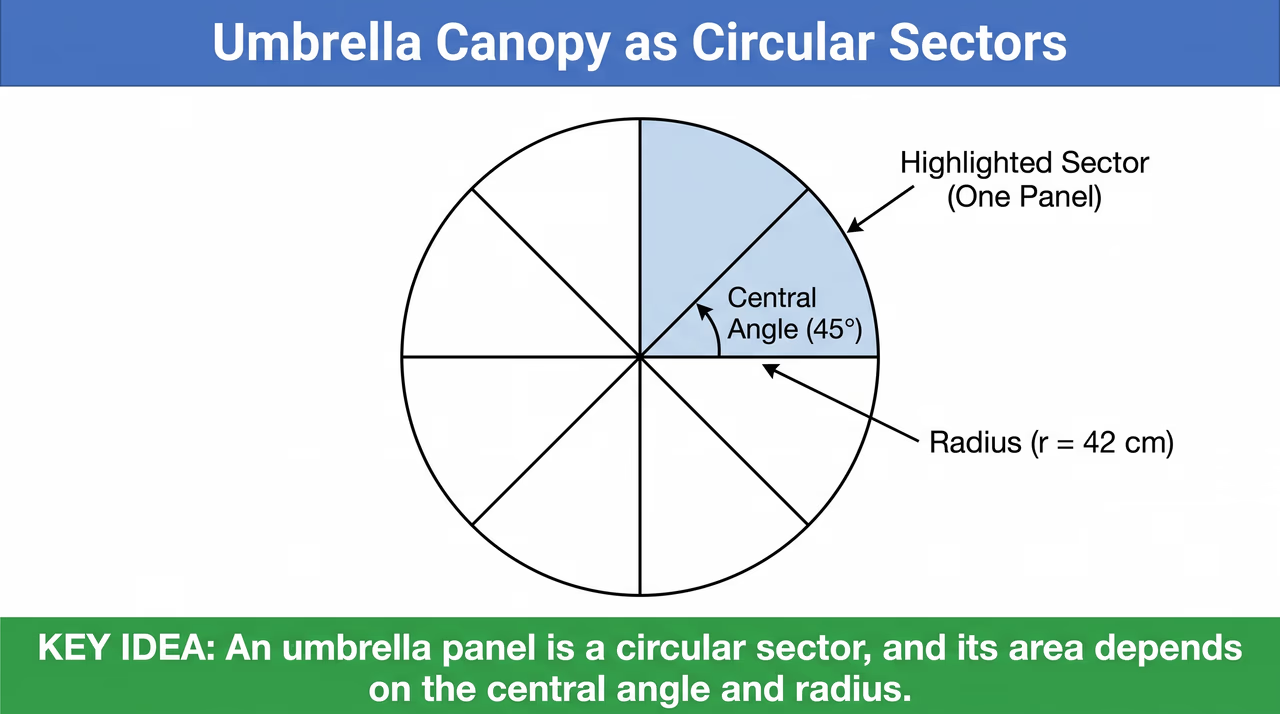
Each fabric panel of the umbrella is subtending a central angle of 45 degrees.

Lesson preview

Slide 1 · Exploring Sector Areas Through Folding and Concentric CirclesOpening · 18 min
A circle divided into four equal quadrants, with one highlighted sector showing a radius of 14 cm and a central angle of 90 degrees.
Figure 1: A circle divided into four equal quadrants, with one highlighted sector showing a radius of 14 cm and a central angle of 90 degrees.

A sector represents a fraction of a full circle defined by its central angle. When we construct a circle of a given radius around a central point, or draw concentric circles, we partition space systematically. Folding a circular cutout into four equal quadrants creates sectors subtending 90°. Since 90° out of 360° is the fraction 90°/360° = 1/4, the sector area is one-quarter of the total circle area. This proportional relationship holds for any central angle θ. Use Figure 1 to visualise the fraction of a circle occupied by a 90-degree sector.

  • Drawing a circle of specified radius establishes the base area for comparing fractional regions.
  • Folding a circular paper into four equal quadrants forms sectors with a central angle of 90°.
  • The fraction 90°/360° simplifies to 1/4, showing the sector takes one-fourth of the circle's area.
  • The formula for sector area uses the ratio of the sector's central angle to 360°.
Worked example. Identify the radius r=14 cm and central angle θ=90∘. Determine the fraction of the full circle: θ360∘=90∘360∘=14. Calculate the area of the full circle: Acircle=πr2=227×142=616 cm2. Multiply the fraction by the total area: Asector=14×616 cm2=154 cm2. Answer: The area of the 90∘ sector is 154 cm2..

Check question: A circular paper cut-out of radius 21 cm is folded into four equal quadrants. What is the area of one quadrant? (Take π=227)

  1. 346.5 cm2
  2. 693 cm2
  3. 1386 cm2
  4. 33 cm2
Show answer

346.5 cm2. A quadrant represents one-quarter of a circle, which means the central angle is 90∘. First, calculate the total area of the circle using A=πr2. The total area is 227×212=1386 cm2. Then, multiply the total area by 14 (which is 90∘360∘) to find the area of one quadrant. The area is 14×1386=346.5 cm2.

Slide 2 · Real-Life Applications of Circular Sector AreasModel · 22 min
A circle partitioned into eight equal sectors representing an umbrella canopy, with one panel showing a 42 cm radius and a 45-degree central angle.
Figure 2: A circle partitioned into eight equal sectors representing an umbrella canopy, with one panel showing a 42 cm radius and a 45-degree central angle.

Teach the full lesson on the projector

This lesson, and every other Grade 1–10 CBE lesson, comes ready to project with the EAP ClassKit. It runs without electricity or internet.

  • Both slides with diagrams and class activities
  • Teacher notes, SNE adaptations and assessment checks
  • Homework and the other 11 lessons in this sub-strand

All 12 lessons in Area of a Part of a Circle

  1. 1Area of an AnnulusDetermine the area of an annulus in different situations
  2. 2Area of an Annulus in Applied ContextsDetermine the area of an annulus in different situations
  3. 3Area of a Sector of a Circle in Real-Life SituationsWork out the area of a sector of a circle in real-life situations
  4. 4Area of a Sector of a Circle in Real-Life SituationsWork out the area of a sector of a circle in real-life situations
  5. 5Area of an Annular SectorDetermine the area of an annular sector in different situations
  6. 6Area of a Segment of a CircleWork out the area of a segment of a circle
  7. 7Area of a Segment of a Circle in ContextWork out the area of a segment of a circle
  8. 8Area of Common Region Between Two Intersecting CirclesDetermine the area of common region between two intersecting circles
  9. 9Applications of Area of Parts of a CircleApply the area of a part of a circle in real-life situations
  10. 10Applying Area of Parts of a Circle in Real-Life SituationsApply the area of a part of a circle in real-life situations
  11. 11Exploring the Area of a Sector in Real-Life ContextsExplore the use of the area of a part of a circle in real-life situations
  12. 12Applications of Area of a Part of a CircleExplore the use of the area of a part of a circle in real-life situations