Slide 1 · Annular Sectors and Circular Segments in DesignModel · 18 min

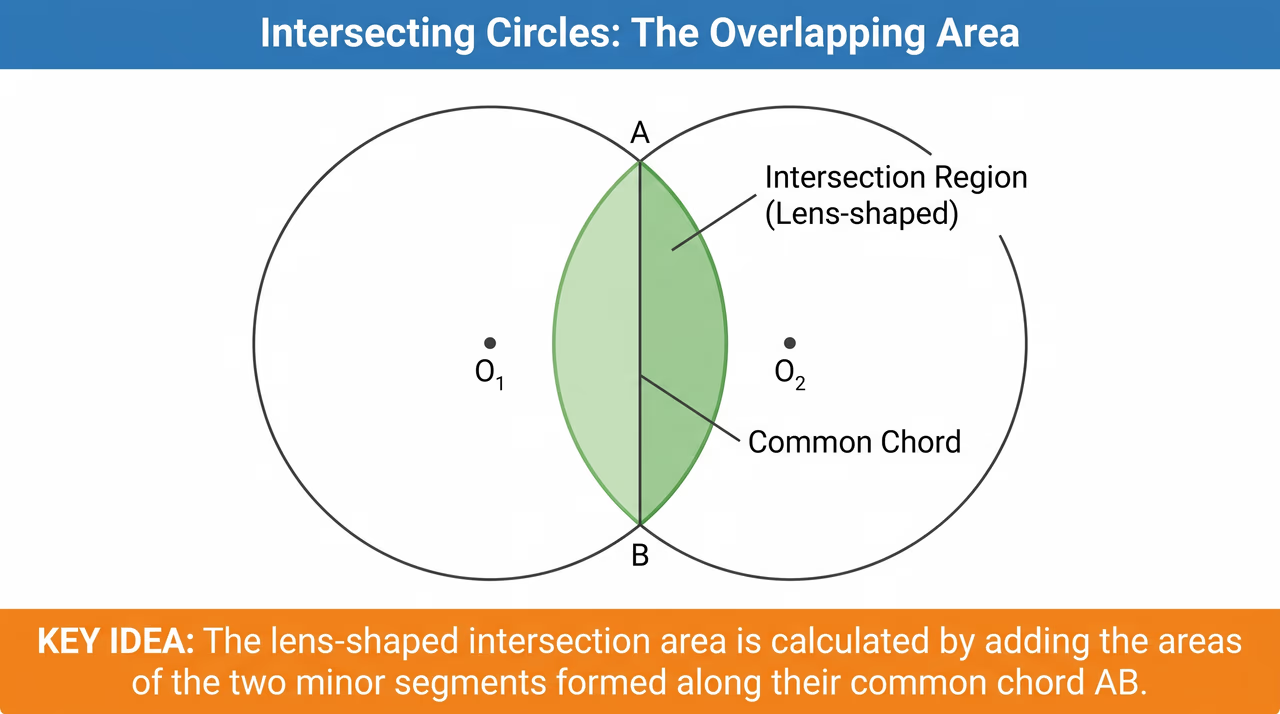
Calculating areas of complex circular shapes in real life involves breaking them into standard components. An annular sector is bounded by two concentric circular arcs and two radii, formed by taking the difference between two sectors of the same central angle. A circular segment is formed by subtracting the area of a central triangle from the area of its corresponding sector. These methods allow architects and engineers to calculate materials for curved structures accurately.
- An annular sector is formed between two concentric circular arcs of different radii sharing a common central angle.
- Subtracting the smaller sector area from the larger sector area yields the exact area of an annular sector.
- A circular segment area equals the sector area minus the triangle area formed by the two radii and chord.
- Real-life architectural layouts use annular sectors and circular segments for efficient spatial planning and tile estimations.
Worked example. Calculate outer sector area: . Calculate inner sector area: . Subtract inner sector area from outer sector area: . Answer: .
Check question: A circular garden of radius has a straight path along chord subtending a central angle of . Calculate the area of the minor segment bounded by chord and the arc. (Take )
Show answer
. Sector area . Triangle area . Minor segment area .